OpenRAMAN
Raman spectroscopy is a powerful technique used to probe the molecular structure of materials by analyzing how light interacts with matter. While the underlying physics can appear complex at first, the core principle is elegant: a laser illuminates a sample, and a small fraction of the scattered light carries a unique signature of its molecular bonds.
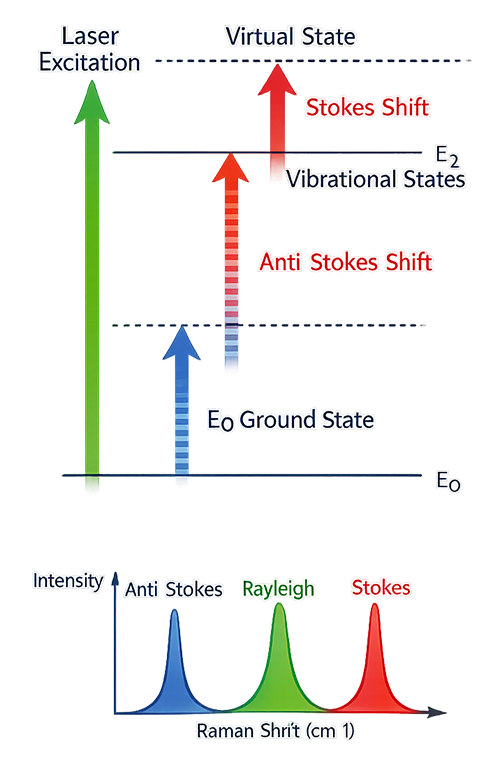
When the laser interacts with a sample, most of the scattered light retains the same energy (Rayleigh scattering). However, a very small portion undergoes inelastic scattering, meaning its energy shifts due to interactions with the vibrational modes of the molecules. These energy shifts appear as Stokes and anti-Stokes lines, corresponding respectively to energy gained or lost by the molecular vibrations, and form the basis of the Raman spectrum.
This extremely weak scattered light is collected by the optical system and directed into a spectrometer for analysis. By measuring the intensity of the signal as a function of the energy shift, the system produces a Raman spectrum—a unique molecular fingerprint that allows each substance to be identified based on its characteristic vibrational signature.
This section brings together a series of in-depth articles designed to guide you through both the fundamentals and practical aspects of Raman spectroscopy. Whether you are new to the field or looking to deepen your understanding, these resources will help you connect theory with real-world measurements and applications.